
Sea & Steel – History – Part 2 of 4
Antonio Vaquera (game designer) is back with the second part of the historical introduction of our game Sea & Steel: Columbus’ Voyages. If you haven’t read the first part you can do it by clicking this link: Read part 1.
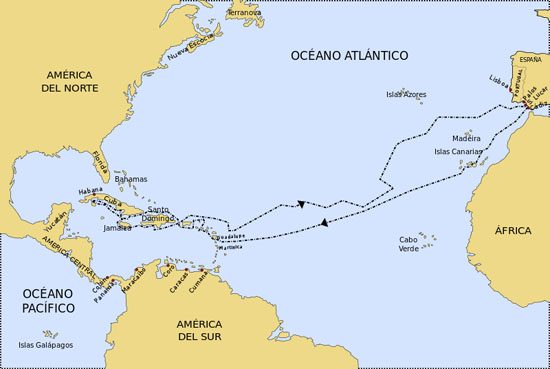
Second Voyage (1493-1496):
September 25, 1493: Columbus sets sail from Cádiz with a fleet of 17 ships and over 1,200 men.
November 3, 1493: Arrives at the Leeward Islands, discovering several islands, including Puerto Rico.
Upon returning to Hispaniola on November 27, 1493, Columbus found the Fort Navidad destroyed and the men he had left behind, dead. Although the exact circumstances are unclear, it is believed that there were conflicts with other Taíno caciques or internal disputes among the Spaniards. Columbus sought out Guacanagari to obtain explanations about what had happened. Guacanagari claimed that he had been attacked by other rival caciques and that he had been unable to protect the Spaniards. He showed wounds that he claimed were the result of these conflicts.
The Indians of Guacanagari explain to the Spaniards that the attack was the work of Caonabó, a warlike Taíno cacique.
After attending to his affairs in La Isabela, Columbus decided to explore the island of Hispaniola on March 12, ordering the construction of the Santo Tomás fortress there by Pedro de Margarit on March 17.

Caonabó attacks the Fortress of Santo Tomás and Alonso de Ojeda, according to Bartolomé de Las Casas, manages to capture him with only 15 men. He is then sent to La Isabela to meet with Columbus, who orders him to be sent to Spain to speak with the kings, considering him an important indigenous leader on the island. However, on the way the ship sinks and Caonabó dies. The Indians of four of the five chiefdoms of the island decide to attack La Isabela to rescue Caonabó and expel the Spanish. The cacique of Marién, Guacanagarí, remains at Colón’s side and alerts him of the attack, so Colón prefers to fight the battle outside. The Battle of La Vega Real will take place about 100 kilometers southeast of La Isabela on March 27, 1495, and will result in a Spanish victory, which will pacify the island.
The Founding of La Isabela Colony:
Columbus chose a new site for the settlement in a natural bay on the north coast of Hispaniola, which offered a strategic location and access to the sea. This place was named La Isabela, in honor of Queen Isabella of Castile.
Starting in December 1493, the colonists began to build the settlement. La Isabela was designed with streets, squares, houses, warehouses, and a church. A port was also built to facilitate the unloading of supplies and future expeditions.

Exploration of Cuba and Jamaica:
In April 1494, Columbus set sail from Hispaniola with a fleet of smaller ships, leaving behind a base of operations in the newly established city of La Isabela.
Columbus reached the southern coast of Cuba on April 29, 1494. He began his exploration near what is now the province of Guantánamo and then sailed westward along the island’s southern coast.
Columbus and his crew had several encounters with the native Taino people of Cuba, who initially greeted them with hospitality. The Taino provided food and other supplies to the explorers.
Subsequently, he sailed south and arrived in Jamaica on May 5, 1494. He landed in a bay that he called Santa Gloria, today known as St. Ann’s Bay. They explored the north coast of Jamaica. They found the island rich in natural resources, with abundant vegetation and water resources. Unlike Cuba, no permanent settlements were established in Jamaica during this voyage.
Columbus also had his first encounters with the Caribs. He landed on several islands, including Guadeloupe and Dominica, where they found signs of the presence of Caribs, such as canoes and structures, who showed hostility towards the Europeans, which led to armed clashes.
The Caribbean people raided other islands and aggressively defended their territories.
They used guerrilla tactics and took advantage of their knowledge of the terrain to oppose the Spanish. These tactics made it difficult for Columbus and his men to operate in the Caribbean islands.
June 11, 1496: Columbus returns to Spain to defend his actions before the Catholic Monarchs.
Continue reading part 3…
 English
  Spanish
2 comments