
Sea & Steel – History – Part 4 of 4

Antonio Vaquera is back with the final chapter in our historical deep dive for Sea & Steel: Columbus’ Voyages.
Catch up on the series here:
Read part 1.
Read part 2.
Read part 3.
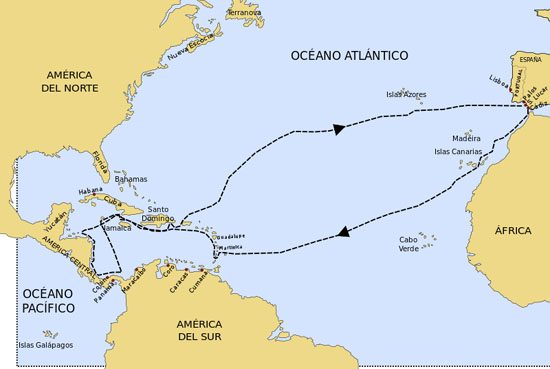
Fourth Voyage (1502-1504)
Columbus was 51 years old, which made him old for the time, and he suffered from gout and arthritis. He set sail with a fleet of two caravels and two ships. The monarchs agreed to finance the fourth voyage on condition that he never set foot on the island of Hispaniola again.
They departed from the port of Seville on April 3, 1502, and arrived in Santo Domingo, on the island of Hispaniola, on June 29. However, the new governor, Nicolás de Ovando, forbade them to disembark, following the orders of the monarchs. So, he sailed to Jamaica to resupply and then followed the coast of Cuba before heading west to the unexplored waters of the Caribbean.
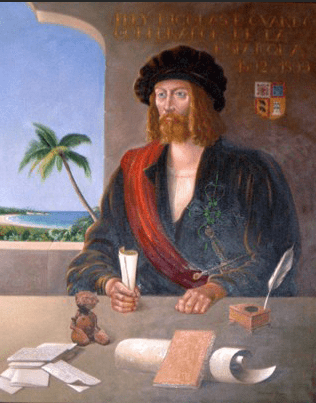
They reached the coast of what is now known as Central America. On December 5, after having traveled practically the entire coast of Central America and with an exhausted crew, he abandoned the search for the western passage and headed for Veraguas, in present-day Panama, because the natives had told him that there was abundant gold.
Resigned to the fact that he could not establish a colony there due to the hostility and the bad weather, Columbus decided to start his way back. However, during the voyage through the Caribbean, all the ships were already affected by the broma (a wood-eating mollusk) and rotten, and they were beginning to sink, at the same time they were also affected by a hurricane.
In June 1503, the surviving ships of the expedition barely managed to reach the island of Jamaica, where they were beached by their crews.
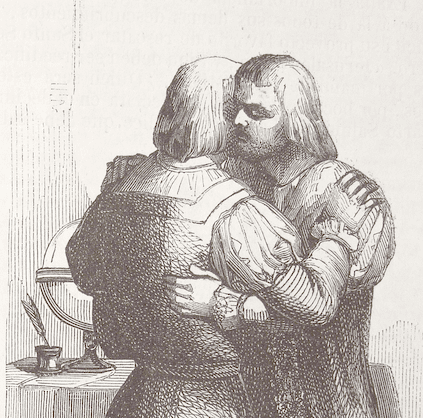
Columbus proposed to Diego Méndez to go by canoe to La Española to ask for help.
Finally, the governor of La Española, Nicolás de Ovando, sent a ship to Jamaica that anchored at a distance. Only the captain’s boat reached the shore, which brought Columbus a roasted pig, some wine, and greetings from the governor.
On June 29, a caravel sent by Diego Méndez finally appeared on the island. At this time, there were 110 members of the expedition left alive.
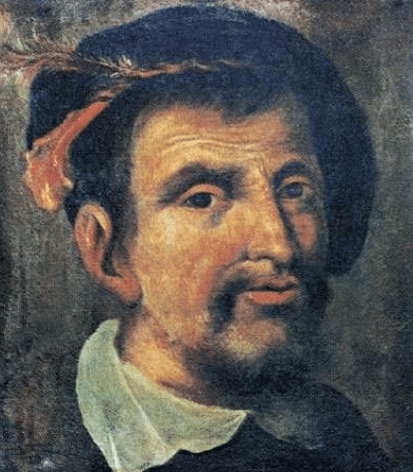
On September 11, 1504, Christopher Columbus and his son Hernando embarked on a caravel to travel from La Española to Spain. They arrived in Sanlúcar de Barrameda on November 7 and from there traveled to Seville.
In Seville, illness kept Columbus bedridden. However, he was able to write his Book of Prophecies and write several letters in which he expressed interest in court affairs. On November 26, Queen Isabella died.

On May 20, 1506, Christopher Columbus died in Valladolid without knowing that his explorations had led him to a continent unknown to the Europeans of his time, which would be called America, the result of an error in attributing its discovery to Amerigo Vespucci.
 English
  Spanish
1 comment